How The Target Was Inspired by New Zealand's Unsolved Trades Hall Bombing
Trailer for a cold case documentary about the Trades Hall bombing
History doesn't often give us answers. It gives us questions.
Sometimes those questions refuse to stay buried.
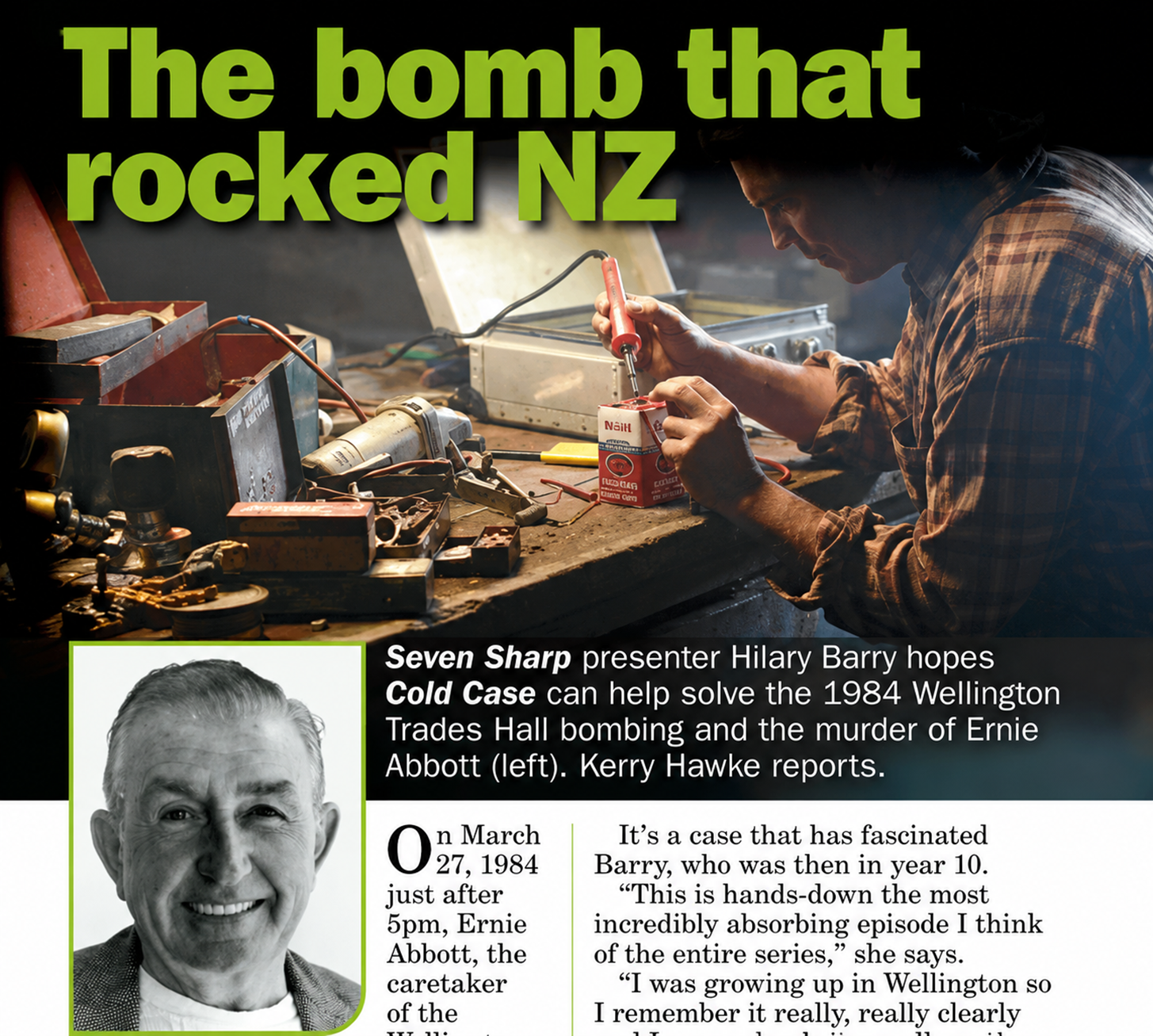
For me, one of those questions began on 27 March 1984, when a suitcase bomb exploded inside Wellington's Trades Hall and killed caretaker Ernie Abbott. More than forty years later, no one has ever been convicted of the bombing. It remains one of New Zealand's greatest unsolved crimes.
People often ask where the idea for The Target came from. They usually expect a simple answer. The truth is far more interesting.
I've long admired the role trade unions have played in improving wages, workplace safety and workers' rights. That interest naturally led me to the Trades Hall bombing, an event that has fascinated me for decades. But what struck me most wasn't simply that someone planted a bomb. It was that an act of political violence serious enough to kill a man could slowly fade from our national memory.
I began wondering what would happen if a similar attack occurred today. How would the police respond? What role would the New Zealand Security Intelligence Service play? How would politicians react? How quickly would misinformation spread across social media? How much surveillance would the public accept in the name of security?
Those questions eventually became woven into The Target.
An Event That Shouldn't Be Forgotten
On 27 March 1984, a suitcase bomb exploded inside Wellington's Trades Hall building. Ernie Abbott, the building's caretaker, was killed when he opened the case. Despite an extensive police investigation, no one has ever been convicted of the bombing.
Today, many New Zealanders know little about the incident. It receives only passing mention in our history, yet it remains New Zealand's only fatal domestic bombing and one of the country's most enduring unsolved criminal investigations.
From Research to Story
I never begin writing a novel with a plot or a detailed outline. Like Stephen King, I start with interesting characters, place them in interesting situations and then I start writing to discover what happens next.
Research runs alongside the writing. I read contemporary newspaper reports from 1984, revisited political commentary from the period and tried to understand the social climate in which the bombing occurred.
The Trades Hall bombing happened at a fascinating moment in New Zealand history. Trade unions were powerful organisations, political divisions ran deep and the country stood on the brink of enormous economic change. New Zealand was about to leave the Muldoon era and enter the sweeping reforms that became known as Rogernomics.
The bombing wasn't simply an isolated criminal act. It occurred during a period of profound political, economic and social tension. Understanding that context helped shape the world in which The Target unfolds. As we build towards the 2026 general election, the environment is eerily similar to 1984.
Why Political Fiction Matters
I've always been interested in stories that entertain while encouraging readers to think. A thriller should keep readers turning pages, but it can also ask difficult questions.
Political fiction occupies an unusual place because it allows writers to explore real issues without claiming to predict the future or rewrite the past. The events of The Target are fictional, as are its characters and plot. But the concerns explored throughout the novel: public trust, surveillance, misinformation, political influence and the role of trade unions are very real.
Throughout history, acts of political violence have altered the course of nations. New Zealand likes to think of itself as being immune from that kind of violence, but history suggests otherwise.
Visiting the Past
One of the unexpected pleasures of writing The Target was discovering just how much material still exists. Photographs, newspaper reports, political commentary and archival records all helped bring the period to life.
The former Trades Hall itself has also become a place where visitors can learn about both the bombing and the wider trade union movement. Standing in the building gives the story a tangible reality that no amount of reading can quite replicate.
From Cold Case to Contemporary Thriller
At first glance, The Target is a fast-moving New Zealand political thriller. It features journalists, intelligence officers, politicians, police investigators and ordinary people caught in extraordinary circumstances. Beneath the suspense, however, lies the same question that first drew me to the Trades Hall bombing. What happens when violence is used to change society?
By setting The Target in a near-future New Zealand, I wanted to explore how familiar institutions might respond when confronted with an event capable of shaking public confidence. How resilient are our democratic institutions? How much freedom are we prepared to surrender in exchange for security?
Bringing Research to Square Edge

Riley Chance holding a photo of front page of 1927 Newspaper - part of the display - dominated by the Trades Hall bombing
Writing a novel is often a solitary process, so it has been immensely rewarding to share some of that journey through my display at Square Edge Arts Centre in Palmerston North.
The display includes newspaper clippings, historical material, photographs and research that helped shape The Target. Visitors can trace the path from a real unsolved crime to a contemporary political thriller, seeing how history gradually evolved into fiction.
One of the pleasures of talking with visitors has been discovering how many people either remember the bombing or are surprised to learn it happened at all.
Many leave wanting to know more about the real event as much as the novel itself. If fiction encourages readers to become curious about New Zealand's history, then it has achieved something beyond entertainment.
Why the Story Still Resonates
The Trades Hall bombing remains unsolved and will probably stay that way. Yet unsolved mysteries endure because they continue asking questions that history cannot answer. As readers follow the investigation, they are also invited to think about democracy, political power, public trust and the forces that continue to shape Aotearoa New Zealand. If the novel sparks conversations about our history as well as our future, then it has done exactly what I hoped it would.
If you're interested in the real history behind The Target, explore the photographs and research from my Square Edge display, read the media coverage discussing the novel's connection to the Trades Hall bombing, or explore my website to learn more about my writing.
You can purchase The Target through my website, from Bruce McKenzie Books or get your favourtite bookstore to order you a copy.